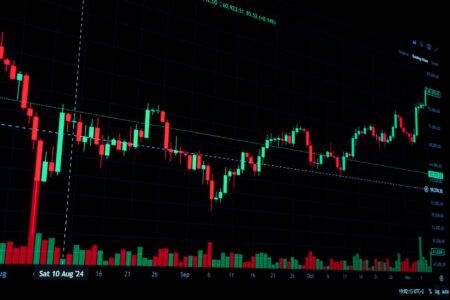



Market turbulence has handed active fund managers their strongest competitive advantage in years, allowing skilled professionals to exploit the blind spots that plague index funds during periods of heightened volatility. While passive strategies have dominated investor flows for the past decade, the current environment exposes fundamental limitations in the “buy everything” approach that defines index investing.
The mathematical simplicity that makes index funds attractive during bull markets becomes a liability when sectors crater or individual stocks face company-specific disasters. Fund managers with the flexibility to avoid troubled areas can sidestep losses that index investors must absorb by design.

Index Funds Face Structural Constraints
Passive funds operate under rigid mandates that prevent portfolio adjustments based on market conditions or fundamental analysis. When the technology sector dominated the S&P 500 in 2021, index investors rode the wave higher but couldn’t escape when the same stocks led markets lower throughout 2022. This mechanical exposure creates opportunities for managers who can identify overvalued sectors before broad-market corrections occur.
The concentration risk within major indices has grown more pronounced over recent years. Apple, Microsoft, and Nvidia now represent significant portions of popular index funds, meaning investors face outsized exposure to a handful of companies regardless of valuation concerns. Active managers can reduce position sizes or exit entirely when fundamental analysis suggests these heavyweight stocks have become overpriced.
Geographic and sector diversification requirements further limit index fund flexibility. A manager tracking the Russell 2000 must own struggling regional banks and challenged retail stocks simply because they meet size criteria, while active managers can avoid entire industries facing secular headwinds. This structural difference becomes more valuable during periods when correlations between stocks break down and stock-picking skills matter more than broad market timing.
Volatility Creates Selection Opportunities
Higher market volatility typically increases the dispersion between winning and losing stocks, creating larger gaps for skilled managers to exploit. During calm markets, most stocks move together, reducing the benefit of individual security selection. When uncertainty rises, company-specific factors drive performance more than broad market sentiment, allowing managers with strong research capabilities to add meaningful value.
The current environment features several sector-specific challenges that active managers can navigate while index investors remain stuck with full exposure. Energy companies face regulatory pressure and transition costs, while certain technology names grapple with slowing growth and elevated valuations after years of outperformance.

Performance Gaps Widen During Stress Periods
Historical data shows active manager performance relative to benchmarks improves during volatile markets and economic uncertainty. The 2008 financial crisis, the dot-com crash, and various emerging market crises all created environments where stock selection mattered more than passive exposure. Managers who avoided heavily leveraged financial stocks in 2008 or overvalued technology names in 2000 generated significant outperformance that lasted for years.
Recent market conditions have begun producing similar performance divergence. Managers who reduced exposure to long-duration growth stocks ahead of Federal Reserve rate increases avoided significant losses, while those who maintained positions in profitable companies with strong balance sheets outperformed during the subsequent recovery. These tactical decisions cannot be replicated by passive strategies that maintain fixed allocations regardless of changing conditions.
The fee differential between active and passive strategies becomes less relevant when active managers can avoid major losses or participate more fully in sector rotations. A manager who sidesteps a 30% decline in a major index component can justify higher fees through downside protection alone. Similarly, managers who can increase exposure to recovering sectors ahead of index rebalancing dates can capture additional returns that passive investors miss.
Bond market volatility has created particularly stark differences between active and passive approaches. Fixed-income index funds must own duration risk and credit exposure based on market capitalization weights, while active managers can adjust duration, credit quality, and sector allocation based on interest rate expectations and credit cycle timing. The dramatic repricing of bonds throughout 2022 and 2023 highlighted these differences, with active managers showing wide performance dispersion while index funds clustered around benchmark returns.

Current market conditions suggest this active management advantage may persist longer than previous cycles. Inflation concerns, geopolitical tensions, and shifting monetary policy create an environment where macro factors drive sector rotation more frequently. The [International ETFs Outpace S&P 500 as Global Markets Shift](https://everydayread.net/international-etfs-outpace-sp-500-as-global-markets-shift/) trend demonstrates how quickly leadership can change between asset classes and regions, creating opportunities for managers with global flexibility that domestic index funds cannot match.
Whether active managers can sustain their recent performance edge depends largely on maintaining the current environment of elevated volatility and sector dispersion. A return to low-volatility, momentum-driven markets would likely restore the passive investing advantage that defined the previous decade.